Showing posts with label jerome. Show all posts

Sunday, 27 November 2016

Jerome: rumours of a disaster.


The Crimean War (1853-1856) was the first war in which the home front could follow the outcome of the various battles within days, thanks to the invention of the telegraph. Modern technology makes it possible that we can watch a war life on television. Not so in Antiquity: it took two years before the news of the sacking of Rome by the Goths in 410 reached Saint Jerome, who was at that time at Bethlehem. It was an utter shock, when slowly and in bits news about this this disaster reached him. As a theologian he immediately recalled to mind Isaiah and the Psalms, but Jerome was also deeply learned in classical literature – his first love which he later so resented – and he could not help but quote Vergil too.

Saint Jerome, Letter 127, 12

Dum haec aguntur in Iebus, terribilis de Occidente rumor adfertur, obsideri Romam et auro salutem civium redimi spoliatosque rursum circumdari ut post substantiam vitam quoque amitterent. Haeret vox et singultus intercipiunt verba dictantis. Capitur  Urbs, quae totum cepit Orbem, immo fame perit ante quam gladio  et vix pauci qui caperentur, inventi sunt. Ad nefandos cibos erupit esurientium rabies et sua invicem membra laniarunt, dum mater non parcit lactanti infantiae et recipit utero, quem paulo ante effuderat. Nocte Moab capta est, nocte cecidit murus eius. Deus, venerunt gentes in hereditatem tuam, polluerunt templum sanctum tuum, posuerunt Hierusalem in pomorum custodiam, posuerunt cadavera  servorum tuorum escas volatilibus caeli, carnes sanctorum tuorum bestiis terrae. Effuderunt sanguinem ipsorum sicut aquam in circuitu Hierusalem et non erat qui sepeliret.
Quis cladem illlus noctis, quis funera fando
Explicet , aut possit lacrimis aequare dolorem?
Urbs antiqua ruit  multos dominata per annos,
Plurima perque vias sparguntur inertia passim
Corpora , perque domos et plurima mortis imago.

Iebus: name for Jerusalem, cf.  Jebusites
obsideo obsedi obsessum: to besiege
redimo redemi redemptum: to buy (in 408 the besieged Romans tried to buy peace with a large amount of gold.)
spolio (-are): to rob plunder
rursum: again
substantia: resources, wealth
haereo haesi: to stick
singultus -us (m.): a sobbing
dictantis: for me dictating this letter
fames famis (f.): hunger
immo….ante quam: (The City) has fallen indeed before by hunger rather than by the sword
vix: hardly
qui caperentur: who could be taken captive
nefandos cibus: heinous nutriment
erumpo erupi eruptum: to burst out. (Here used as a vivid and rhetorical description for what the esurientium rabies (the madness of the hungry) has led to.)
invicem: mutually
lanio (-are): to tear in pieces, butcher
parco peperci parsum (+ dat.): to save, spare
lacto: to suck milk
infantia: children (collective use of the singular.)
dum..effuderat: This rhetoric is far beyond what we would nowadays consider palpable…
recipit (in) utero: received in her belly
effundo effudi effusum: to pour out, give girth
Nocte eius: Is. 15, 1
Deus...sepeliret: Ps. 79, 1-3
Posuerunt custodiam:  They have turned …into an orchard (pomorum custodiam. This translation is from the Septuagint, which has ὀπωροφυλάκιον. The Hebrew has a different word, meaning `ruims’.)
esca: food
volatilibus cœli: for the birds of the sky
circuitus –us (m.): surrounding
Hierusalem: Hebrew words are not declined
Quis…imago: Verg. Aen. II 361-365
clades cladis (f.): destruction, slaughter
fando: by speaking
lacrimis aequare dolorem: i.e. there are not enough tears to equal the pain
urbs: Troy
spargo sparsi sparsum: to scatter
iners inertis: motionless
plurima imago: the manifold image, face
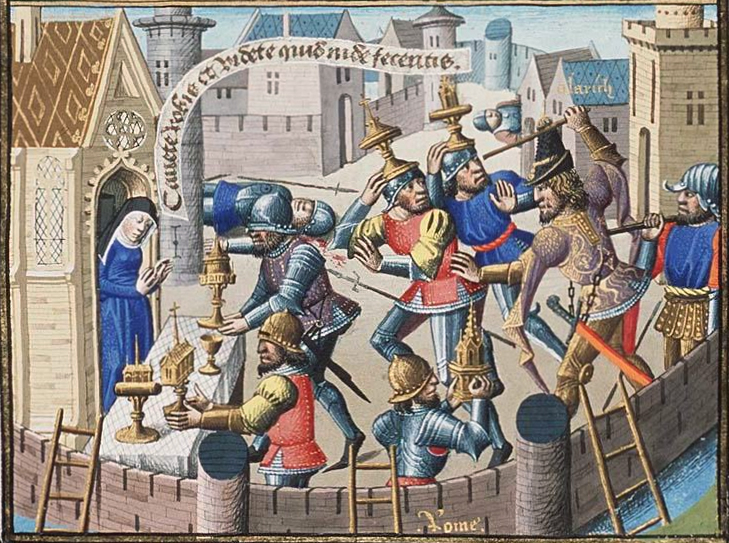


Sack of Rome by Alaric - sacred vessels are brought to a church for safety. Picture from a French manuscript (1475)

Translation:  Nicene and Post-Nicene Fathers, Second Series, Vol. 6.  (1893) (old fashioned, sometimes misleading and incomplete, but the only available on internet )

12. Whilst these things were happening in Jebus a dreadful rumour came from the West. Rome had been besieged and its citizens had been forced to buy their lives with gold. Then thus despoiled they had been besieged again so as to lose not their substance only but their lives. My voice sticks in my throat; and, as I dictate, sobs choke my utterance. The City which had taken the whole world was itself taken; nay more famine was beforehand with the sword and but few citizens were left to be made captives. In their frenzy the starving people had recourse to hideous food; and tore each other limb from limb that they might have flesh to eat. Even the mother did not spare the babe at her breast. In the night was Moab taken, in the night did her wall fall down. Isaiah 15:1 O God, the heathen have come into your inheritance; your holy temple have they defiled; they have made Jerusalem an orchard. The dead bodies of your servants have they given to be meat unto the fowls of the heaven, the flesh of your saints unto the beasts of the earth. Their blood have they shed like water round about Jerusalem; and there was none to bury them.
Who can set forth the carnage of that night?
What tears are equal to its agony?
Of ancient date a sovran city falls;
And lifeless in its streets and houses lie
Unnumbered bodies of its citizens.
In many a ghastly shape does death appear.


Thursday, 11 April 2013

Why St. Jerome despiced Roman authors...


If St. Jerome could have had it his way, nothing of Classical literature would have come down to us.  Jerome (347-420) studied rhetoric and philosophy at Rome and had a deep reverence and love for Roman writers. It was after these studies that he converted to Christianity. Jerome was a gifted man: singlehandedly he translated the Bible. For the Old Testament he learned Hebrew, but modern scholars suspect that he had more than one eye on the Greek text of the Septuagint. As if I am making a translation from a Loeb edition into Dutch, but in reality from the English translation of the facing page… He had a complex character and one of his greatest gifts was making trouble wherever he came. Nowadays we would call him a religious zealot. Many letters by him have been preserved and among this mass of letters his correspondence with St. Augustine. Initially it started friendly, but later on Jerome accused St. Augustine of all kinds of faults. St. Augustine had the greatest trouble to stay polite. They had a different position in the church: St. Augustine was bishop, having to deal with everyday worries of his flock. Jerome was a hermit and founder of monasteries, having problems dealing with people not completely agreeing with him. Despite being a great misogynist (or because of?) he collected a circle of mainly rich women around him. To this circle belonged Paula and her daughter Eustochium. Paula was a rich widow, who supported Jerome financially. She and her daughter followed him like true devotees follow a guru.
In a letter to Eustochium, Jerome tells about an experience he had by which he completely abandoned reading classics. The problem was that the reading of classics distracted him from reading and appreciating the Scriptures. At a certain time during Lent Jerome was fasting and while fasting he fell ill and had severe fevers. In one of his fevers he experienced that his soul was taken away and put before God. Asked what he was, Jerome answered that he was a Christian. `You are a liar! You are not a Christian, but a Ciceronian!’ God answered and then for the sake of his eternal life, Jerome does away with his classical library.
Let us be glad that all those monks – Roman and Orthodox –, who faithfully copied classical texts, have not followed his advice….

{30] Cum ante annos plurimos domo, parentibus, sorore, cognatis et, quod his difficilius est, consuetudine lautioris cibi propter caelorum me regna castrassem et Hierosolymam militaturus pergerem, bybliotheca, quam mihi Romae summo studio ac labore confeceram, carere non poteram. Itaque miser ego lecturus Tullium ieiunabam; post noctium crebras vigilias, post lacrimas, quas mihi praeteritorum recordatio peccatorum ex imis visceribus eruebat, Plautus sumebatur in manibus. Si quando in memet reversus prophetam legere coepissem, sermo horrebat incultus, et quia lumen caecis oculis non videbam, non oculorum putabam culpam esse, sed solis. Dum ita me antiquus serpens inluderet, in media ferme quadragesima medullis infusa febris corpus invasit exhaustum et sine ulla requie—quod dictu quoque incredibile sit—sic infelicia membra depasta est, ut ossibus vix haererem. Interim parabantur exsequiae et vitalis animae calor toto frigente iam corpore in solo tam tepente pectusculo palpitabat, cum subito raptus in spiritu ad tribunal iudicis pertrahor, ubi tantum luminis et tantum erat ex circumstantium claritate fulgoris, ut proiectus in terram sursum aspicere non auderem. Interrogatus condicionem Christianum me esse respondi: et ille, qui residebat, ‘Mentiris,’ ait, ‘Ciceronianus es, non Christianus; ‘ubi thesaurus tuus, ibi et cor tuum.’’ Ilico obmutui et inter verbera—nam caedi me iusserat—conscientiae magis igne torquebar illum mecum versiculum reputans: ‘In inferno autem quis confitebitur tibi? ’ Clamare tamen coepi et heiulans dicere: ‘Miserere mei, domine, miserere mei’ Haec vox inter flagella resonabat. Tandem ad praesidentibus genua provoluti, qui adstiterant, precabantur, ut veniam tribueret adulescentiae, ut errori locum patientiae commodaret, exacturus deinde cruciatum, si gentilium litterarum libros aliquando legissem. Ego, qui tanto constrictus articulo, vellem etiam maiora promittere, deiurare coepi et nomen eius obtestans dicere: ‘Domine, si umquam habuero codices saeculares, si legero, te negavi.’ In haec sacramenti verba dimissus revertor ad superos et mirantibus omnibus oculos aperio tanto lacrimarum imbre perfusos, ut etiam incredulis fidem facerent ex dolore. Nec vero sopor ille fuerat aut vana somnia, quibus saepe deludimur. Teste est tribunal, ante quod iacui, iudicium teste est, quod timui—ita mihi numquam contingat talem incidere quaestionem!—liventes habuisse me scapulas, plagas sensisse post somnum et tanto dehinc studio divina legisse, quanto mortalia ante non legeram.

domo….cibi: the ablatives are depending on castrassem: I cut myself off from
lautioris cibi: of very lavish food (lautus is the ppp of lavo: `to wash, bath’, The fact that the ppp has developed to that meaning – like lavish from the other ppp lavatus denotes the importance of bathing in Roman social customs!)
propter caelorum regna castrassem: allusion to Matth 19:12: sunt enim eunuchi qui de matris utero sic nati sunt et sunt eunuchi qui facti sunt ab hominibus et sunt eunuchi qui se ipsos castraverunt propter regnum caelorum qui potest capere capiat (For there are eunuchs, who were born so from their mothers womb: and there are eunuchs, who were made so by men: and there are eunuchs, who have made themselves eunuchs for the kingdom of heaven. He that can take, let him take it.)
Hierosolym: Jerusalem (many writers don’t decline Hebrew names, but Jerome does)
militaturus: becoming a sodier for Christ is a metaphore coined by S. Paul, but at the time Jerome is writing it is a technical term for becoming a hermit)
studium: zeal
careo (+ abl.): to miss, do without
Tullium: Cicero
ieiuno: to fast (I fasted in order to read Cicero afterwards)
creber: numerous
vigilia:  watch
praeteritorum recordatio peccatorum: the remembrance of the previous sins (i.e. the having read classics, while trying to abstain from them)
ex imis visceribus: from my inner deep
eruo erui erutum: to throw out
Plautus: Roman writer of comedies
in memet reversus: coming back to myself
prophetam: the prophets, but also as pars pro toto for the Bible
sermo incultus: uncultivated language (St. Augustine had the same experience when he read the Bible for the first time)
caecus: blind
antiquus serpens: the Devil
dum… inluderet: In classical Latin dum never takes the subjunctive, but in late Latin the subjunctive was seen as the mood indicating a sub clause.
quadragesima: In eccl. Lat., the Christian fast of forty days, Lent
medulla: marrow (medullis = in medullis, so: deep inside)
sine ulla requie with depasta
depascor depastus sum: to eat away, consume
ossibus vix haererem: I hardly stuck to my bones
exsequiae: funeral
vitalis animae calor: the heat of the life giving soul
toto frigente iam corpore: abl. abs.
tepens, entis: luke-warm
in pectusculo: in my poor little breast
palpito: to tremble
ad tribunal iudicis: the judge is of course God
pertraho –traxi –tractus: to draw forcibly (There is no need to think of this experience as made up by Jerome. Fasting and fever can induce hallucinations and having apparently a spiritual crisis, it is no wonder his hallucinations went into this direction.)
tantum (+gen.): so much of
circumstantium: the Angels
fulgor oris (m): brightness
sursum: upwards
Interrogatus condicionem Christianum me esse respondi: asked about my background, I answered that I was a Christian.
mentior: to lie
ubi thesaurus tuus, ibi et cor tuum: Matt. 6:2
ilico: on that very spot
obmutesco obmutui: to become dumb
verber verberis (n): lash, scourge
caedo cecidi caesum: to beat
torqueo torsi tortus: to twist, torture
reputo: to reflect upon
In inferno autem quis confitebitur tibi? Psalm 6:6 quoniam non est in morte recordatio tui in inferno quis confitebitur tibi (For there is no one in death, that is mindful of thee: and who shall confess to thee in hell?)
heiulo: to wail
flagellum: whip
genua provoluti: bending their knees towards i.e. kneeling towards
precor: to beg, pray
veniam tribuo (+dat.): to give forgiveness for
adulescentiae: Jerome was still a young man when he had this experience,
ut errori locum patientiae commodaret: to give room for patience for my fault, i.e. forgiveness,
gentilis: pagan
exigo cruciatum: to endure torture
tanto constrictus articulo: stressed by such a moment
deiuro: to swear, take an oath
obtestor: to call as witness
In haec sacramenti verba dimissus: `released because of the words of this promise”
superos: the people above
aperio oculos perfusos tanto imbre lacrimarum. Not the use of the present tense `I open’ to give a lively touch to this narrative
imber imbris (m): shower, heavy rain
sopor, soporis (m): sleep
liveo: to be black and blue
scapulae: schoulders
dehinc: there after


About Jerome:
Translation (scroll down to section 30):  


Orazio Borgianni - The Vision of St Jerome (ca. 1600)